
Frequently Asked Questions
-
EMS stands for Electric-Muscle Stimulation.
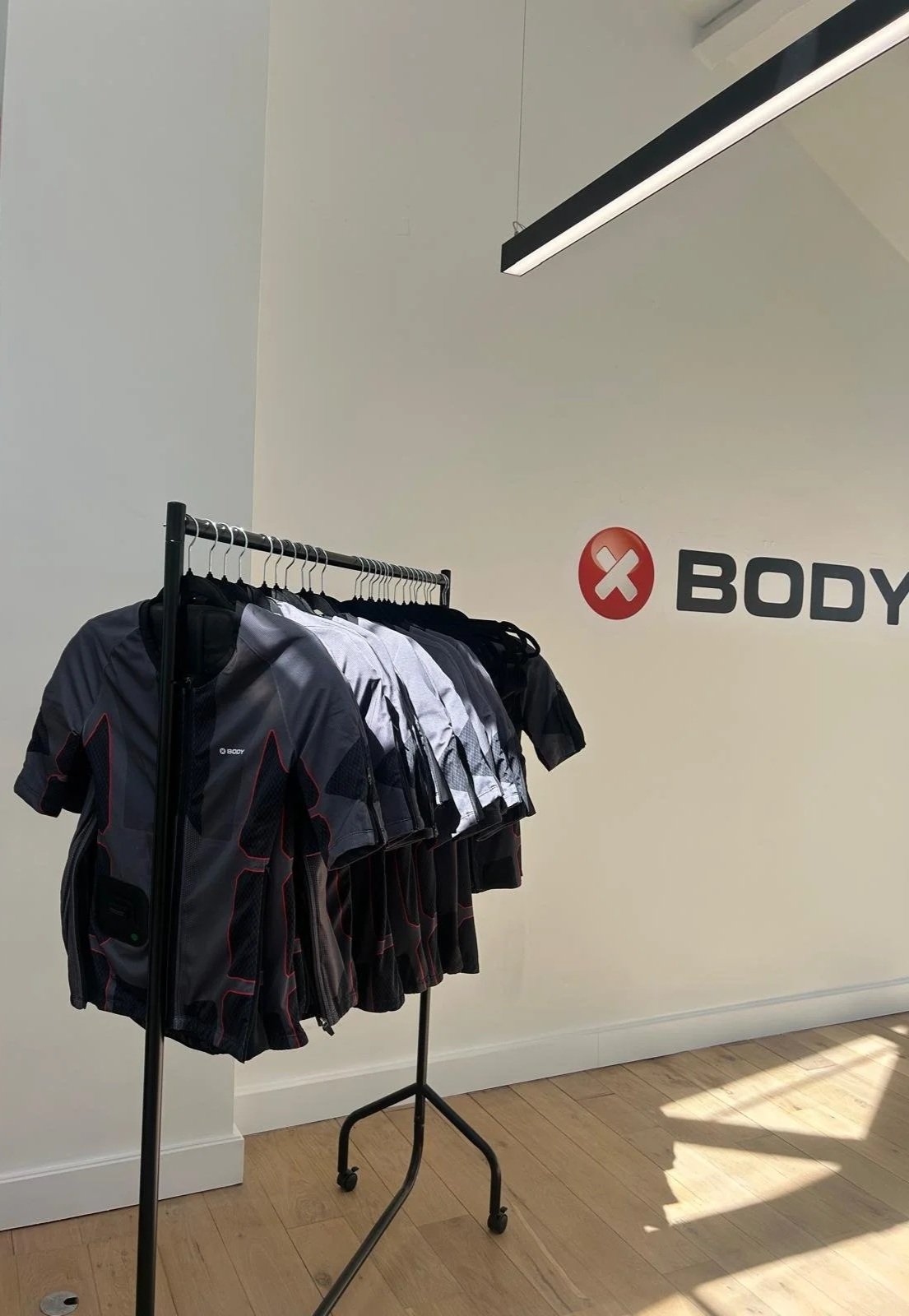
During a session, gentle electrical impulses are delivered to the muscles through a specialist suit. These signals mimic the body’s natural nerve impulses — meaning your muscles contract more deeply and more frequently than they typically would during a standard workout.
When paired with guided movements, this creates a high-efficiency, full-body strength session. -
A normal workout recruits muscle fibres gradually and often in isolation. EMS allows a much higher percentage of muscle fibres — including deep stabilising muscles — to activate simultaneously.
As a result, in around 20 minutes, you achieve targeted, controlled muscular work that would usually take much longer -
Deep stabilisers often don’t switch on fully during conventional exercise, especially if posture, fatigue or compensations are involved.
EMS bypasses this by stimulating muscles directly via the nervous system, encouraging balanced activation across both large and small muscle groups at the same time. -
Yes — when delivered using professional equipment under trained supervision.
EMS technology has long been used in physiotherapy and sports rehabilitation to stimulate muscles safely. In fitness EMS, intensity and duration are carefully programmed so sessions are effective, controlled and appropriate for each individual. -
Most people describe it as a firm, rhythmic, pulsing sensation in the muscles.
It shouldn’t be painful — and you remain in control of the intensity at all times. Your trainer will always start gently and increase gradually as your confidence and tolerance builds -
EMS is an active workout, not passive.
You perform simple, controlled movements while the stimulation is applied, which helps train coordination, posture and functional strength — not just muscle contraction alone. -
EMS training will suit all fitness levels — from complete beginners to experienced athletes.
Because intensity is personalised, you don’t need to be fit to start. Many people choose EMS because it’s joint-friendly, time-efficient, and supportive when returning to exercise. -
Yes. EMS is often chosen by people restarting fitness because sessions are low-impact, guided and adaptable.
Movements are simple, and load comes from controlled muscle activation rather than heavy weights. -
Most people feel stronger, more activated and more energised after just a few sessions.
Visible or measurable results typically develop over 4–6 weeks with consistency, depending on goals, recovery, sleep and nutrition. -
For most people, 1–2 sessions per week is ideal.
Because EMS activates a high number of muscle fibres at once, your body needs rest days between sessions to adapt and strengthen. -
Yes — EMS supports strength, muscle tone and body composition by stimulating lean muscle activity.
For fat loss specifically, nutrition, sleep and daily movement habits still play a major role. EMS is a powerful training tool — not a magic shortcut. -
Yes. A professional EMS suit activates the major muscle groups simultaneously, including:
- core
- back
- chest
- arms
- glutes
- legs
- deep stabilisersYour trainer can also prioritise specific areas depending on your goals.
-
Yes. Intensity can be fine-tuned across different muscle groups, allowing trainers to address weaknesses, asymmetries or specific performance goals in a controlled way.
-
You wear a specially designed base layer beneath the EMS suit.
This ensures:
· even contact with electrodes
· hygiene
· comfort
· consistent stimulationYour studio will provide clear guidance on exactly what to bring.
-
You’ll be:
Welcomed and screened for suitability
Fitted into your base layer and EMS suit
Guided through intensity setup at a gentle level
Led through simple, controlled movements
Taken through a cool-down, review and next steps
Everything is fully supervised and paced for beginners.
-
Mild muscle soreness is common — similar to a strong workout.
It usually settles within 24–72 hours. Hydration, light movement and rest all support recovery. -
EMS can strengthen the core and postural muscles, which may support alignment and everyday movement.
It is not a medical treatment, so anyone with pain or injury should seek professional advice first. -
Yes. EMS is an an excellent joint-friendly way to maintain muscle mass and functional strength as we age.
Sessions are always adapted to the individual. -
Absolutely. Many people use EMS as a performance-boosting complement to their existing training — supporting strength, posture and stability.
-
TENS units and massage guns are designed mainly for pain relief or relaxation.
Fitness EMS is full-body, supervised and intensity-controlled, specifically engineered to stimulate muscle contraction for training purposes. -
Every session is guided 1:1 or 1:2 by a certified trainer who sets intensity, coaches movement and monitors technique and safety.
This ensures training is effective, personalised and controlled. -
Yes. EMS may not be suitable for people with certain conditions such as pacemakers, implanted medical devices, uncontrolled medical conditions, pregnancy or acute illness.
You’ll complete a screening form, and medical clearance may be advised where appropriate. -
Your trainer controls:
· pulse strength
· duration
· frequency
· rest intervalsThis allows EMS to be tailored for beginners, rehab-supportive training or advanced performance work.
-
Because EMS activates more muscle fibres at once, muscles work harder in a shorter period — even during simple movement patterns.
That’s why 20 minutes delivers a highly efficient, full-body strength session